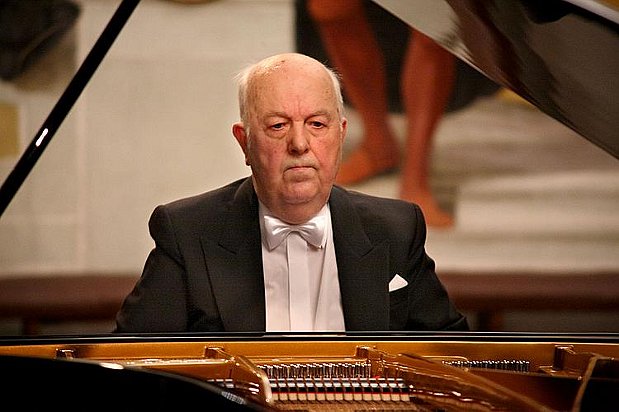
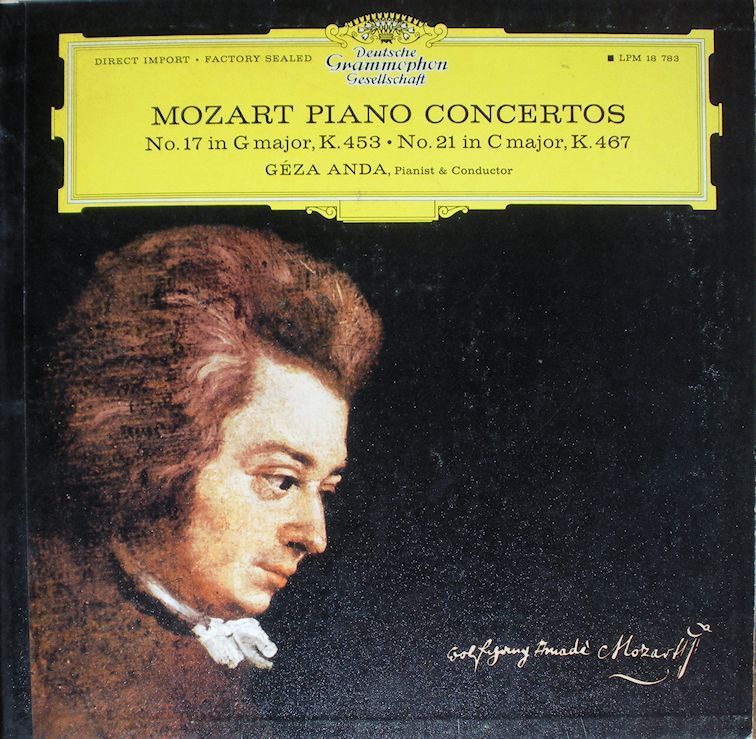
The past two years, I've remembered Géza Anda's passing on this blog. I was so busy this year I forgot. I've been listening to a lot of Ivan Moravec these days, but I pulled out some of my favorite Anda recordings again. The Schumann Fantasie and Symphonic Etudes played by Anda are always interesting. He can really rush things sometimes. I think I should pull out the Mozart piano concerto set I was given last Christmas too. I've been listening to Murray Perahia's set in my car.
Tonight, I figured out how to make receipts from a MySQL database. It's nothing fancy. I just used PHP to read the records from MySQL and then had it generate numbered receipts by using HTML tables to format them. I also figured out how to use PHP to display an RSS feed on this page. I really like open source. My default office suite is LibreOffice. Python, Inkscape and Audacity are among the other open source tools I use. I used Audacity to analyse sound and I used it in my kid's grade 4 class to check who could play a violin note in tune.
Today, a student had trouble with a Powerpoint file generated from a Mac app (not Office Mac). I had asked her to save it as PPTX, but that was not possible as she didn't have Office Mac. I converted the slides to images and was about to insert an image library into Powerpoint 2010 when I remembered an online conversion service. The Mac PPT wouldn't load into Powerpoint 2010 but it did load into LibreOffice 3.5 with glitches (funny how the open source product worked better huh?). I remembered a service I had used successfully before. I did a Google search "z format conversion" and found Zamzar. The offending PPT was uploaded to Zamzar and within a few minutes, I was sent an e-mail with a link to the converted file. Voila, it worked! The audio files were in M4A format. I tried VLC Player to convert to MP3 without success. Next I used Adobe Soundbooth to convert M4A to MP3 and it worked. Finally, I use Audacity to edit her 3 converted MP3 audio clips together as the background music for the PPT. I am more familiar with Audacity than SoundBooth (that's why I didn't edit and merge the clips from SoundBooth).
Thursday, June 20, 2013
Sunday, June 2, 2013
Piano Recital Day
Today was piano recital day for students of the Saskatoon Yamaha Music School. In the afternoon, there were group lesson recitals and in the evening, there was a wide variety of music from private lesson students. Their teacher played a Mozart fantasia to start off the evening recital. It wasn't KV 475, but maybe it was KV 397. I must admit I don't listen to very much solo Mozart. Incidentally, we heard the Twinkle variations this morning on the radio (I think it was Janina Fialkowska's recording) on the way to the Forestry Farm Park. The Ohio Buckeyes are starting to bloom there.
We have an Ohio Buckeye in our backyard and it blossomed for the first ime last year. I admired the European Horse Chestnuts in Toronto when they bloomed in June. They are a common street tree in southern Ontario. I saw some beautiful specimens by the lake in Oakville last summer. It's too cold to grow them in Saskatchewan, so I planted an Ohio Buckeye on 2008 August 30.
This year, I've been listening to several Ivan Moravec solo albums. I got his Vox Chopin album from Passionato (now defunct it seems). There is a Youtube that goes with this album. Unfortunately, my CD had a pressing defect and I ordered another through Amazon.ca Marketplace. I'm still immersed in this Chopin album after first hearing it in February. Next I got the Vox double CD album of Chopin and Debussy. I don't appreciate Debussy too much, but the Chopin is a favorite CD now. Love the Polonaise Fantasie! I've always liked Pollini's version, but this one has better, fuller sound. I also got his double CD of Mozart concerti with Marriner. Finally, a 4 CD piano recital box has recently arrived and I'm looking forward to a summer of Ivan Moravec's playing.
| Ohio Buckeye, Forestry Farm Park |
| Ohio Buckeye Blossom |
This year, I've been listening to several Ivan Moravec solo albums. I got his Vox Chopin album from Passionato (now defunct it seems). There is a Youtube that goes with this album. Unfortunately, my CD had a pressing defect and I ordered another through Amazon.ca Marketplace. I'm still immersed in this Chopin album after first hearing it in February. Next I got the Vox double CD album of Chopin and Debussy. I don't appreciate Debussy too much, but the Chopin is a favorite CD now. Love the Polonaise Fantasie! I've always liked Pollini's version, but this one has better, fuller sound. I also got his double CD of Mozart concerti with Marriner. Finally, a 4 CD piano recital box has recently arrived and I'm looking forward to a summer of Ivan Moravec's playing.
Monday, May 27, 2013
Salvaging a password protected laptop
I had the task of trying to resurrect an older Dell Inspiron laptop. Unfortunately, somebody set a hardware password on the BIOS. Unlike a desktop, this is not a simple matter of setting a jumper to erase the password. I was stuck.
Then I thought, if I could install Windows Vista on the laptop hard drive with another machine (in this case a Dell desktop), I could then pop the hard drive back into the laptop and see if it would boot with the reinstalled Windows Vista. Unfortunately, I got the blue screen of death. No luck. I suppose if I could get my hands on a similar Dell Inspiron laptop, this could work.
However, I then thought of trying Ubuntu Linux. I took out the laptop hard drive again and hooked it up to the Dell desktop. I installed Ubuntu 12.04 LTS using the Dell desktop. LTS stands for long term service release and this means that version (relaeased in April 2012) will be supported for five years (until April 2017). Ubuntu Linux releases occur every 6 months in October and April. Every 2nd year, there is an LTS release in April. Then I put the hard drive back into the laptop and booted from Ubuntu Linux. It worked. I had to let it get software updates. Some of the usual annoyances occured:
Then I thought, if I could install Windows Vista on the laptop hard drive with another machine (in this case a Dell desktop), I could then pop the hard drive back into the laptop and see if it would boot with the reinstalled Windows Vista. Unfortunately, I got the blue screen of death. No luck. I suppose if I could get my hands on a similar Dell Inspiron laptop, this could work.
However, I then thought of trying Ubuntu Linux. I took out the laptop hard drive again and hooked it up to the Dell desktop. I installed Ubuntu 12.04 LTS using the Dell desktop. LTS stands for long term service release and this means that version (relaeased in April 2012) will be supported for five years (until April 2017). Ubuntu Linux releases occur every 6 months in October and April. Every 2nd year, there is an LTS release in April. Then I put the hard drive back into the laptop and booted from Ubuntu Linux. It worked. I had to let it get software updates. Some of the usual annoyances occured:
- needed to get VLC Player so it could play DVDs
- needed to get the propietary driver for the wireless network card
- needed to update Flash from the Software Centre so it could play Youtube
- needed to install IcedTea with the Firefox plugin so Java applets could run.
Monday, May 20, 2013
Victoria Day 2013
A full day and some photos of the garden. Only one Russian Mammoth sunflower sprouted from my first planting. I'm trying again with a second planting, but it is kind of late this year.
The Saskatoon berries are in bloom.
The Ohio Buckeye is starting to leaf as well.
In previous years, the Norland apple would already be blossoming. This apple tree split at the main trunk during a storm in 2010 when it was loaded with a crop of apples. It is healing well as we taped it together and it looks like it self-grafted itself nicely. The little spruce seedling from last year did not survive though.
We also had a nice trip to the Barry Barn.
Peking Duck was on the menu for lunch!
The Saskatoon berries are in bloom.
The Ohio Buckeye is starting to leaf as well.
In previous years, the Norland apple would already be blossoming. This apple tree split at the main trunk during a storm in 2010 when it was loaded with a crop of apples. It is healing well as we taped it together and it looks like it self-grafted itself nicely. The little spruce seedling from last year did not survive though.
We also had a nice trip to the Barry Barn.
Peking Duck was on the menu for lunch!
Thursday, May 16, 2013
Drumheller in May
I had the opportunity to accompany students to Red Deer, Alberta for the Festival of Bands. On the way back, we stopped off at the Royal Tyrell Museum. The aspens are still in their fresh lime green hue. One of my favorite times of the year!
I always get a kick out of that sign! Here is an aspen:
Robert Frost describes this time of year so perfectly:
Nothing Gold Can Stay
Nature's first green is gold
Her hardest hue to hold.
Her early leaf's a flower;
But only so an hour.
Then leaf subsides to leaf.
So Eden sank to grief,
So dawn goes down to day.
Nothing gold can stay.
I always get a kick out of that sign! Here is an aspen:
Robert Frost describes this time of year so perfectly:
Nothing Gold Can Stay
Nature's first green is gold
Her hardest hue to hold.
Her early leaf's a flower;
But only so an hour.
Then leaf subsides to leaf.
So Eden sank to grief,
So dawn goes down to day.
Nothing gold can stay.
Friday, May 10, 2013
Got Raspberry Pi Running
This post was done on a Raspberry Pi running a version of Debian Linux. The credit card sized board has 512 M RAM, an SD Card slot, an ethernet port and two USB ports. I used an LG cell phone charger with 4.8 V at 700 mA to power it. I also tried Scratch and Pygame on it. The board was $55, the plastic case for it is $20 (ordered from Amazon.ca). It can be bought for the original $35 price from here. It is connected to my LG TV via HDMI. I was using the Wheezy Debian distro.
One of the annoyances you may come across right away is when you try to type the @ symbol with shift 2 (it gives you a "). This is because Raspberry Pi Debian distro is set for UK keyboard by default. You need to type shift apostrophe to get the @ symbol on a North American keyboard.
Thursday, April 25, 2013
Spectrum of a sodium vapor street light
I took the Carolina $10 spectroscope outside to observe the spectrum of a sodium vapour street lamp (the orange coloured ones). I read lines at 500 nm, 515, nm and 590 nm. Here is the sodium spectrum
Looking at the two part spectrum the lines I observed are indicated with arrows. I also observed some of the blue lines, but couldn't make out the position on the ruler.
Monday, April 22, 2013
Cheap spectroscopy
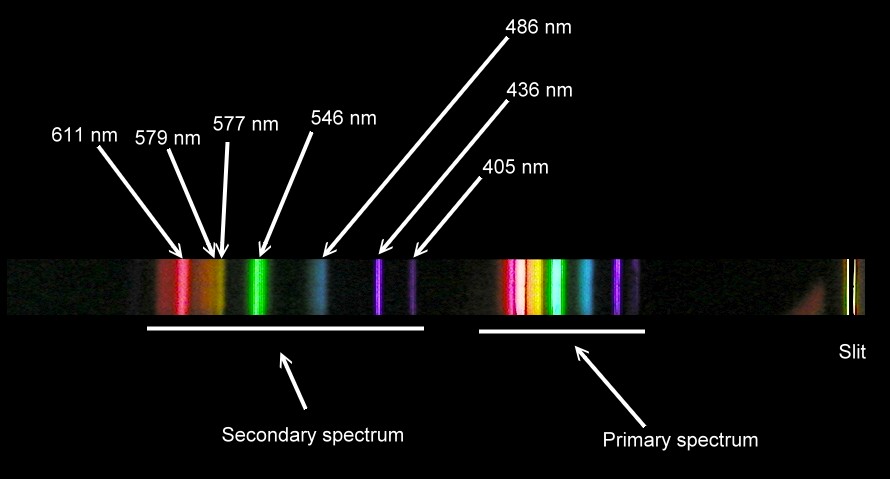
I bought a $10 Carolina spectroscope from Merlan. I pointed it at a CFL bulb and took a photo of the spectrum:
Now compare it to the mercury spectrum:
The spectrum peaks are at 435.835 nm (blue), 546.074 nm (green), a pair at 576.959 nm and 579.065 nm (yellow-orange). There are two lines at 404.656 nm and 407.781 nm and a faint line at 491.604 nm.
Compare this to the labelled spectrum of a fluorescent light from this site:
You can actually see the purple line with the spectroscope (it doesn't show up on the photo). When I read the wavelengths from the spectroscope, it matches the numbers shown in the reference photo. This is pretty good for $10!
When I pointed the spectroscope at a halogen lamp, the spectrum was more like a rainbow (full spectrum lighting). This simulates natural sunlight much better than a CFL. This link explains this phenomena very well.
A complete library of atomic spectra is found here. This is very old, but it shows how to take better pictures of spectrometer spectra (click here).
I've also used this to look at the spectrum of a sodium vapour street light.
Sunday, April 21, 2013
Dorian Recordings
In the 1990s, BMG Music Service setup shop in Canada briefly and competed with Columbia House. It was great as I now had access to the PolyGram catalog (DG, Decca, Philips) at a discount. They also happened to offer CDs from Dorian, a small American lablel. Along the way, I was introduced to Custer LaRue's recording of American folk songs by Bob Kerr (CBC Stereo, Off the Record).
One of the songs on this CD was the theme to the Friendly Giant. Bob Kerr also introduced me to Juilanne Baird's recording of John Downland's song, Come Again (sheet music here). Sting has performed this song too. I had not listened to this Julianne Baird CD for maybe 10 years and I pulled it out yesterday to listen to it. Glorious! It is certainly a young person's song.
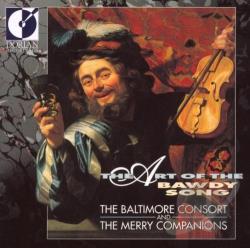
Also, I heard about "The Art of the Bawdy Song" with the Baltimore Consort. Rather more boorish music (and lyrics) here.
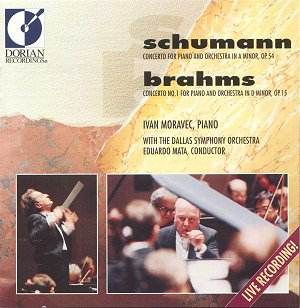
I was drawn back to these Dorian Recordings because on April 18th, my recording of Ivan Moravec playing the Schumann and Brahms Piano concerti arrived. I had tried unsuccessfully to get it new from Amazon.ca, but an Ontario seller on Amazon.ca Marketplace had a used one for sale. I've been listening to a lot of Ivan Moravec's Chopin from his Vox recordings lately.
How lucky that I have these fabulous Dorian CDs in my collection!
One of the songs on this CD was the theme to the Friendly Giant. Bob Kerr also introduced me to Juilanne Baird's recording of John Downland's song, Come Again (sheet music here). Sting has performed this song too. I had not listened to this Julianne Baird CD for maybe 10 years and I pulled it out yesterday to listen to it. Glorious! It is certainly a young person's song.
I was drawn back to these Dorian Recordings because on April 18th, my recording of Ivan Moravec playing the Schumann and Brahms Piano concerti arrived. I had tried unsuccessfully to get it new from Amazon.ca, but an Ontario seller on Amazon.ca Marketplace had a used one for sale. I've been listening to a lot of Ivan Moravec's Chopin from his Vox recordings lately.
How lucky that I have these fabulous Dorian CDs in my collection!
Monday, April 15, 2013
Sir Colin Davis
This morning, I heard the news of Sir Colin Davis' passing from an e-mail from Presto Classical. I admired Sir Colin Davis for his Mozart conducting. As a high schooler, I enjoyed the Philips records he made with Stephen Kovacevich. The first Davis recording I had was a Philips Festivo LP of Mozart's Prague and Jupiter symphonies. It was one of the first recordings of the Jupiter in which I heard the repeats in the final movement.
This morning, it happened that their recording of Mozart's KV 467 was playing in my car. I think that is my favorite recording of KV 467. Kovacevich's ornamentations in the slow movement really caught my ear the first time I heard it.
He is a musician I will miss, but we are so lucky that his recordings live on.
Saturday, April 13, 2013
Some irrational beauty of mathematics
In computer science, I often refer to two infinite alternating series:
ln(2):
and the Leibniz expansion of π/4:
When I saw these two infinite series in first year calculus, I was fascinated that such a simple pattern would result in something meaningful (it made me think there must be a God indeed!).
Now, π is a familiar irrational number, but e (Euler's number) is less well know. When I took MAT319, Introduction to Complex Analysis (the only optional math class I ever took as an undergrad), we were shown de Moivre's formula
and we were shown the much simpler Euler formula:
This is the formula Richard Feynman called "one of the most remarkable, almost astounding, formulas in all of mathematics." Why is this so important? Well, the Fourier transform requires this remarkable fact!
It is much easier to deal with exponentials than trig functions, so Fourier transforms are usually expressed as above. Why are Fourier transforms so important? Well, any application of digital signal processing requires it! When we try to remove noise from a signal (TV, radio, seismic etc), we need to be able to find the frequencies in the signal and the Fourier transform does that for us. So the images we see from various earth orbiting satellites like RadarSAT would not be possible without the Fourier transform (and Euler's formula). Euler's number (e) is a remarkable number indeed!
This example of using Audacity to analyse sound uses the Fourier transform. The frequency spectrum was computed with a Fast Fourier Transfer (FFT).
Now, I am not very good at mathematics, but I do admire and appreciate it's beauty and utility. That's probably why I admire Michael Faraday above all other scientists (he wasn't very good at math like James Clerk Maxwell was). When some of my computer science students said "your smart", I rebutted, "no I'm not" and told the story of my ordeal in APM346 (Partial Differential Equations). The class was taught by G F D Duff, FRSC. I was confused from the very start because he used a different notation from the textbook he assigned (and I'm just not that great at math). When he walked in to return the midterms, he said "the grades ranged from 0 to 100%. The class average was 33%" and then proceeded to get on with the class. The guy sitting next to me said "Hey, I did twice as well as you - I got 2/20". Seeing failure in my future, I went to see a physics prof and asked if I could take the geophysics classes next year if I failed the class. He told me "stay in the class, if he doesn't change the grade, governing council will". So, I stayed in the class, didn't bother to study for the 60% final (because I had quantum mechanics the day before and was in low spirits), answered only 2 of the 6 question on the final exam (I was admiring the woodwork in West Hall, University College for the last 15 minutes contemplating my failure). I got 52% (D-) and was so happy to pass!
It's not being 'smart' that matters. It's the willingness to learn something new. And, as I get older, I realise that if something is difficult, it means I'm actually learning something new. One of the concepts from APM346 that confused me was Bessel Functions. During coffee break in grad school, one of my colleagues moved his styrofoam cup across the table and said, "look at the Bessel functions" in response to the ripples that were forming in the cup. It was at that time it dawned upon me that Bessel functions are used to solve boundary value problems in cylindrical coordinates. You don't have to know why they work (at least as a scientist), you just have to know that for cylindrical geometry, Bessel functions work! And, for spherical coordinates, Legendre polynomials work (I heard that in Derek York's Physics of the Earth class in fourth year).
ln(2):
and the Leibniz expansion of π/4:
When I saw these two infinite series in first year calculus, I was fascinated that such a simple pattern would result in something meaningful (it made me think there must be a God indeed!).
Now, π is a familiar irrational number, but e (Euler's number) is less well know. When I took MAT319, Introduction to Complex Analysis (the only optional math class I ever took as an undergrad), we were shown de Moivre's formula
and we were shown the much simpler Euler formula:
This is the formula Richard Feynman called "one of the most remarkable, almost astounding, formulas in all of mathematics." Why is this so important? Well, the Fourier transform requires this remarkable fact!
It is much easier to deal with exponentials than trig functions, so Fourier transforms are usually expressed as above. Why are Fourier transforms so important? Well, any application of digital signal processing requires it! When we try to remove noise from a signal (TV, radio, seismic etc), we need to be able to find the frequencies in the signal and the Fourier transform does that for us. So the images we see from various earth orbiting satellites like RadarSAT would not be possible without the Fourier transform (and Euler's formula). Euler's number (e) is a remarkable number indeed!
This example of using Audacity to analyse sound uses the Fourier transform. The frequency spectrum was computed with a Fast Fourier Transfer (FFT).
Now, I am not very good at mathematics, but I do admire and appreciate it's beauty and utility. That's probably why I admire Michael Faraday above all other scientists (he wasn't very good at math like James Clerk Maxwell was). When some of my computer science students said "your smart", I rebutted, "no I'm not" and told the story of my ordeal in APM346 (Partial Differential Equations). The class was taught by G F D Duff, FRSC. I was confused from the very start because he used a different notation from the textbook he assigned (and I'm just not that great at math). When he walked in to return the midterms, he said "the grades ranged from 0 to 100%. The class average was 33%" and then proceeded to get on with the class. The guy sitting next to me said "Hey, I did twice as well as you - I got 2/20". Seeing failure in my future, I went to see a physics prof and asked if I could take the geophysics classes next year if I failed the class. He told me "stay in the class, if he doesn't change the grade, governing council will". So, I stayed in the class, didn't bother to study for the 60% final (because I had quantum mechanics the day before and was in low spirits), answered only 2 of the 6 question on the final exam (I was admiring the woodwork in West Hall, University College for the last 15 minutes contemplating my failure). I got 52% (D-) and was so happy to pass!
It's not being 'smart' that matters. It's the willingness to learn something new. And, as I get older, I realise that if something is difficult, it means I'm actually learning something new. One of the concepts from APM346 that confused me was Bessel Functions. During coffee break in grad school, one of my colleagues moved his styrofoam cup across the table and said, "look at the Bessel functions" in response to the ripples that were forming in the cup. It was at that time it dawned upon me that Bessel functions are used to solve boundary value problems in cylindrical coordinates. You don't have to know why they work (at least as a scientist), you just have to know that for cylindrical geometry, Bessel functions work! And, for spherical coordinates, Legendre polynomials work (I heard that in Derek York's Physics of the Earth class in fourth year).
Wednesday, March 6, 2013
Windows 8 USB 3.0 Problems
I think the power management in Windows 8 screwed up my NEC Chipset four port USB 3.0 PCI-E card. After the computer went to sleep, the USB 3.0 ports didn't work. Rebooting didn't help. Reinstalling the Rensas driver didn't help. Shutting the computer down, turning off the power bar, waiting, then rebooting got the USB 3.0 ports back up and running. However, I think two of the ports still aren't working:
Tuesday, February 19, 2013
Beethoven Opus 111
I'm am just crazy about the last 3 piano sonatas of Beethoven. Last year, Opus 109 consoled me in mourning. Then, as I listened more to Opus 111, it pierced my soul as much as the other solo piano works I love (Schumann Opus 13, Schumann Opus 17, Brahms Opus 24, Brahms Opus 118, Nr 2, Chopin Barcarolle). There is a part in the last movement that sounds jazzy. This is followed by a part that just blows me away -- trills and chords together. I have a DVD of Kocsis playing this sonata and it makes you appreciate how hard it is to play. Wow. Today, Bruce Hungerford's recording of it arrived from Passionato. I like it. I also like Pollini. For sheer beauty of sound, Simone Dinnerstein is unbeatable. This is why so many regard Beethoven as the greatest of them all. Click here for some insights on Hungerford's Beethoven.
Lego Mindstorms NXT 2.0
I got another set of Lego Mindstorms NXT 2.0 today. Their uncle bought them one for Christmas in 2010 I believe. This should keep the kids busy!
It uses a version of Labview to program the bots:
If you want to do something sort of like this, Scratch is free and pretty fun. You can also program your Android phone with AppInventor.
It uses a version of Labview to program the bots:
If you want to do something sort of like this, Scratch is free and pretty fun. You can also program your Android phone with AppInventor.
Sunday, February 17, 2013
Opera - I think I'm going to get hooked
In this era of DVD, I finally am taking to opera. In the DG 111 box I have, there are several operas which I have yet to view
- Der Rosenkavalier (Kleiber)
- Carmen (Karajan)
- Don Giovanni (Furtwängler)
- La Traviata (Barenboim)
I watched the DVD of Rigoletto (McVicar production) I have and I quite like it. The most famous tune is at the start of the third act. I have another McVicar production on the way - Manon and I'm looking forward to listening to Natalie Dessay's singing.
Subscribe to:
Posts (Atom)