
Monday, January 27, 2014
François-Frédéric Guy - Beethoven Piano Sonatas

Wednesday, January 22, 2014
New Living Translation
This Bible arrived in the mail yesterday. My son was asking if he could take his Bible to school to read as he saw some other student bring a Bible to read. I told him to take a Good News Bible to school. He started to look at this new one as well.
 I've had a Living Bible for a while, but don't often read it. This website has critical reviews of various Bible translations. The Living Bible is not highly regarded by scholars because it is a paraphrase like the Good News Translation. For a kid, it might be a good way to get into the Word of God. A lot easier than the New King James Version (grade 8 level). He has a NIRV Bible too, but it's falling apart (that's at a grade 3 level).
Wednesday, January 15, 2014
Tableau Public - Data Visualisation in a Snap
I was searching for some data for my CS20 students to analyse when I happened upon Tableau Public. This ComputerWorld Article discusses 22 visualisation tools and Tableau Public is among them. Here are some resources for it:
- Short PDF tutorial
- Getting Started (Duke University LibGuide)
Monday, January 13, 2014
Genetics Problem and Combinations
In the Saskatchewan Grade 9 textbook, there is a lab on genetics (page 57). One of the questions is to figure out how many different combinations of fruit fly possibilities based on the following traits
LL CC WW = Long legs, Tan, Long Wings
LL CC ww = Long legs, Tan, Short Wings
LL cc WW = Long legs, Ebony, Long Wings
LL cc ww = Long legs, Ebony, Short Wings
ll CC WW = short legs, Tan, Long Wings
ll CC ww = short legs, Tan, Short Wings
ll cc WW = short legs, Ebony, Long Wings
ll cc ww = short legs, Ebony, Short Wings
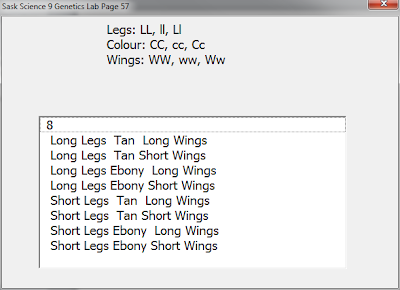
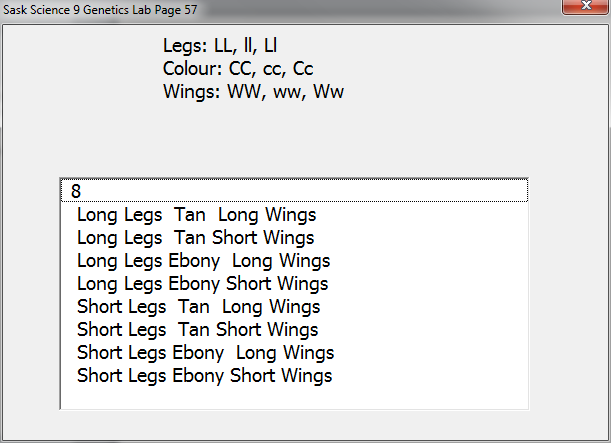
I think it would have been even easier to write the code in Python, but I wouldn't have the GUI interface easily like I do with VBA.
- Long Legs (L) or Short Legs (l)
- Tan Colour (C) or Ebony Colour (c)
- Long Wings (W) or Stubby Wings (w)
- {LL, ll, Ll}
- {CC, cc, Cc}
- {WW, ww, Ww}
- LL and Ll are both long legs, whereas ll is short legs
- CC and Cc are both tan colour, whereas cc is ebony colour
- WW and Ww are both long wings, whereas ww is short wings
- {LL, ll}
- {CC, cc}
- {WW, ww}
LL CC WW = Long legs, Tan, Long Wings
LL CC ww = Long legs, Tan, Short Wings
LL cc WW = Long legs, Ebony, Long Wings
LL cc ww = Long legs, Ebony, Short Wings
ll CC WW = short legs, Tan, Long Wings
ll CC ww = short legs, Tan, Short Wings
ll cc WW = short legs, Ebony, Long Wings
ll cc ww = short legs, Ebony, Short Wings
I think it would have been even easier to write the code in Python, but I wouldn't have the GUI interface easily like I do with VBA.
Sunday, January 12, 2014
Dementia and Music
This story from The National suggests early music education can stave off dementia later in life. I was curious about this and looked up the following
Joel Osteen mentions in his latest book, Break Out!, that the physical expression of dementia was found in the brains of some people who never exhibited the symptoms of dementia.
- CNN article from Sept 2013
- Scholarly article about Swedish twins and this topic
- Music therapy for dementia patients
Joel Osteen mentions in his latest book, Break Out!, that the physical expression of dementia was found in the brains of some people who never exhibited the symptoms of dementia.
Friday, January 3, 2014
A load of laughs arrived today

 |
| Framed Cat |
Thursday, January 2, 2014
Some interesting programming tools for kids
I downloaded the latest Portable Python versions today. Interestingly, Portable Python 2.7 lets you use the Python 3 syntax for the print statement. It doesn't work perfectly, but at least it doesn't crash your program. I also found a new Pygame textbook on the Pygame site. Programming Arcade Games with Python and Pygame could be used as a textbook for an intro Python course (click here). It's not free like Al Sweigart's Pygame books, but the website version is free.

One of the bugs I've been finding with the Scratch 2.0 offline editor is that the sprites get 'off-centre' and this can make it look like your program isn't working properly (x,y coordinates seem off). This is a persistent, unpredictable bug in this beta software. A few 10 year olds are finding Scratch more fun than Lego Mindstorms EV3. They are quite interested in how many views their Scratch projects have had. I also hear things like "can you remix this on my computer". Scratch is super-cool. One of them was even looking into Pygame for a little. This great, free resource has Scratch tutorials that truly engage 10 year olds! Here is the Space Invaders project made from a tutorial from TeachICT.com. I like using Creative Commons audio clips from SoundBible.com in my Scratch Projects.
One of the bugs I've been finding with the Scratch 2.0 offline editor is that the sprites get 'off-centre' and this can make it look like your program isn't working properly (x,y coordinates seem off). This is a persistent, unpredictable bug in this beta software. A few 10 year olds are finding Scratch more fun than Lego Mindstorms EV3. They are quite interested in how many views their Scratch projects have had. I also hear things like "can you remix this on my computer". Scratch is super-cool. One of them was even looking into Pygame for a little. This great, free resource has Scratch tutorials that truly engage 10 year olds! Here is the Space Invaders project made from a tutorial from TeachICT.com. I like using Creative Commons audio clips from SoundBible.com in my Scratch Projects.
 |
| Scratch 2.0 Offline Editor Bug - Sprite is off-centre |
Tuesday, December 31, 2013
Drawn with Inkscape

This was drawn today with Inkscape. The SVG file is here. Not too bad for an open source vector drawing program.


Audacity was also used to analyse the frequencies of some drums. Click here for the analysis.

Friday, December 27, 2013
Google Coder finally setup!
I had tried without luck to get Google Coder to work on my wired network at home. Today, I got it setup on a wireless network. I had to get the Raspberry Pi connected to the wireless network with the WiFi tool (needed to run startx from the command line to do this). Once I manually typed in the SSID and WPA key, I rebooted the Raspberry Pi. I had to install Bonjour Print Services on the Windows 8.1 laptop and finally, it works!
This is the screen shot of the laptop

 |
| Raspberry Pi on left and Windows 8.1 laptop on right |
This is the screen shot of the laptop
Wednesday, December 25, 2013
Nine years ago today, the Huygens Probe was launched from Cassini
I just finished watching the third episode of Wonders of the Solar System this afternoon. It started with Brian Cox taking a flight on the English Electric Lightening to the edge of the atmosphere. I admired pictures of this airplane from the Hamlyn Children's Dictionary I poured over as a child.
There was also a segment about the meteorite that struck Saskatchewan in 2008.
The thing that caught my attention was when Cox said the Huygens probe of the ESA separated from Cassini and headed towards Saturn's moon, Titan, on Christmas Day 2004. It actually landed on Titan's surface on 2005 January 14.
 This picture taken by the Huygen's probe on Titan shows rocks that look similar to those in riverbeds on Earth. In fact, Titan is the only other place in the solar system that is known to have an earth-like atmosphere. The difference is, since the gravity on Titan is much less than earth and it's much colder than earth (more than 10x farther away from the sun than earth), methane instead of water is what shapes Titan's atmosphere. In fact, the only other lakes known in the solar system are found on Titan - lakes of methane.

There was also a segment about the meteorite that struck Saskatchewan in 2008.
The thing that caught my attention was when Cox said the Huygens probe of the ESA separated from Cassini and headed towards Saturn's moon, Titan, on Christmas Day 2004. It actually landed on Titan's surface on 2005 January 14.
Monday, December 23, 2013
Wonders of the Solar System

The fifth episode was about life on other planets. Apparently, there is a 100 km deep ocean beneath the ice sheet covering Europa. It is hypothesised that Europa is a likely candidate for extra-terrestrial archaea based upon observations of archaea in the ice of Iceland. Bacteria which digest H2S and excrete sulphuric acid are common in some hotspots on the earth. The main point of this episode was to compare how life found in extreme conditions on earth can provide parallels for some places in the solar system.
The first episode was about the sun. He talks about how the sun is 400 times farther from the earth than the moon and also 400 times bigger in diameter than the moon (click here for spreadsheet) and this is why we have perfect solar eclipses on occasion. Not a coincidence I think (that's the Hand of God). He goes over briefly the H-R diagram and sun spot activity that correlated with water flow in a South American river. The importance of Earth's magnetic field in diverting the solar wind and channeling solar particles to the poles to create the northern lights is also covered. Brian Cox describes how with a can of water and a watch, one can figure out that the sun gives off 1 kWatt/square metre on the surface of the earth "and that's why I love physics".
The second episode is about how the solar system formed and focuses on how Saturn and its rings and moons are a microcosm of how the solar system formed. Cox uses his simple model to show how the ancients observed the retrograde pattern of Mars' motion in our night sky. There is a lot of mention of how conservation of angular momentum is a fundamental law that applies to anything from the draining of water in a sink to tornadoes to the formation of the solar system. I think this is why the outer planets orbit at a slower speed than the inner planets. I like how Cox mentions he wrote to JPL and asked for the first photos from the Martian surface which were taken by Viking in 1955 (and he got them). I remember, as a kid saving Edmonton Journal clippings of the launch of Voyager in 1977 and the old Radio Shack comic books they gave out which talked about the space age. I had a copy of the 1979 comic book at one time which has a picture of Voyager I on the cover.
One of the interesting concepts described in the second episode was orbital resonance of Jupiter and Saturn when they line up together. This was the reason for the Late Heavy Bombardment.
Saturday, December 21, 2013
Murray Perahia - The First Forty Years
Finally cracked open this wonderful set yesterday evening. I started by listening to Perahia's first Beethoven sonata recording. I had the LP of this recording which was never released on CD until now. The CD sounded cleaner than my LP as the sfz parts weren't so clangorous as I remember them. But maybe the SPL monitors and Yamaha receiver have something to do with that!

I've listened to a lot of late Beethoven sonatas recently, and these sonatas didn't move me as much as I remember from way back in high school. The first movement of the fourth sonata is as ebullient as ever though.
This morning, I watched the DVD of Mozart's KV 467 and KV 595 with the Chamber Orchestra of Europe. I've long had the CD and didn't know there was a companion video. The conversations about the music between Perahia and Sir Denis Forman were very illuminating. My older son said "they [the orchestra] get it right away and they're young". Very enjoyable and educational indeed. I have long thought KV 595 foreshadowed Mozart's own death and circumstances (it was first performed the year of his death). The poignant Larghetto is very touching. Perahia explores the darkness of the first movement quite thoroughly. The bucolic last movement rondo reminds me of Brahms' second piano concerto's final movement.
Next, I listened to Chopin's 3rd Sonata. I've listen to Valerie Tryon's recording of this beautiful sonata quite a lot and I never had Perahia's recording. Not disappointed at all. This was one of his first recordings shortly after his triumph at the Leeds Competition.

Next up are the Schumann Symphonic Etudes. I once had this CD, but gave it to someone else. I love Pollini and Anda in this music as well.

I think I take Murray Perahia for granted. In the hard cover book included, he says he took to Beethoven quite late and he hasn't played Opus 111 yet. I hope he does so soon and I also wonder when he'll record the Brahms Piano Concerti. His core of Mozart, Schumann, Chopin and Brahms are shared with my own tastes. He has played a lot of Bach of late (that is a composer I haven't fully gotten 'into' yet). And, of course, Beethoven is always a presence!

I've listened to a lot of late Beethoven sonatas recently, and these sonatas didn't move me as much as I remember from way back in high school. The first movement of the fourth sonata is as ebullient as ever though.
This morning, I watched the DVD of Mozart's KV 467 and KV 595 with the Chamber Orchestra of Europe. I've long had the CD and didn't know there was a companion video. The conversations about the music between Perahia and Sir Denis Forman were very illuminating. My older son said "they [the orchestra] get it right away and they're young". Very enjoyable and educational indeed. I have long thought KV 595 foreshadowed Mozart's own death and circumstances (it was first performed the year of his death). The poignant Larghetto is very touching. Perahia explores the darkness of the first movement quite thoroughly. The bucolic last movement rondo reminds me of Brahms' second piano concerto's final movement.
Next, I listened to Chopin's 3rd Sonata. I've listen to Valerie Tryon's recording of this beautiful sonata quite a lot and I never had Perahia's recording. Not disappointed at all. This was one of his first recordings shortly after his triumph at the Leeds Competition.

Next up are the Schumann Symphonic Etudes. I once had this CD, but gave it to someone else. I love Pollini and Anda in this music as well.

I think I take Murray Perahia for granted. In the hard cover book included, he says he took to Beethoven quite late and he hasn't played Opus 111 yet. I hope he does so soon and I also wonder when he'll record the Brahms Piano Concerti. His core of Mozart, Schumann, Chopin and Brahms are shared with my own tastes. He has played a lot of Bach of late (that is a composer I haven't fully gotten 'into' yet). And, of course, Beethoven is always a presence!
Wednesday, December 18, 2013
A notable day
This afternoon, I heard someone defend the Christian origins of Canada and it was a heartfelt defence of our country's roots. I was impressed. This evening, I heard some young school children sing Silent Night as part of their Christmas concert. Wonderful! Finally, the Magnasonic DVD player that stopped working last week actually works now. I prayed about it while I was exercising and thought, "it's a minor thing for you God, but you can fix anything". So after I finished on the NordicTrak, I tried to play a CD in it. I remember giving it a smack and it played. Then I played Mutter's Mendelssohn Violin Concerto DVD and it played for a while, then started to break up. Then I stuck in Pollini's DVD of Beethoven's 3rd and 5th Piano Concerti. It played! I think I had to smack it to get it to work (the Hand of God at work). Then I stuck in my DVD of Rigoletto and it played (no smacking required). BELIEVE!

Sunday, December 15, 2013
Windows 8.1 glitch on Asus Intel Chipset Mainboard
I had previously wrote about this problem, but it arose again this morning. I searched about this problem and found this. I had to get rid of the Asus USB 3.0 Speedboost utility. I can use my USB mouse again. The weird thing was, my computer would not play midi files either!
My other Windows 8.1 Pro computer (Phenom 6-core) had a problem with Internet Explorer 11 crashing upon startup. Recent Windows Updates seem to have fixed that problem.
This is why people hate Windows. However, Mac OS isn't perfect either.
My other Windows 8.1 Pro computer (Phenom 6-core) had a problem with Internet Explorer 11 crashing upon startup. Recent Windows Updates seem to have fixed that problem.
This is why people hate Windows. However, Mac OS isn't perfect either.
Saturday, December 7, 2013
Delphi to the rescue again
I couldn't find a good, free RSS feed manager, so I wrote my own in Delphi 7 a few years ago. To assist with implementing Xibo digital signage at an elementary school, I was updating my RSS feed generator written in Delphi XE:

I had to modify the program to get the RSS feed from an URL (instead of using FTP). A quick Google search "delphi xe save file from url" and found this gem from StackOverflow. I thought it would be a quick fix, but I forgot the phrase "I imported the type library for WinHTTP, " I eventually figured out how to do this and I was up and running quickly.
This is why real developers use Delphi to code real apps! It's a lot more productive than using C++ or Java!
I had to modify the program to get the RSS feed from an URL (instead of using FTP). A quick Google search "delphi xe save file from url" and found this gem from StackOverflow. I thought it would be a quick fix, but I forgot the phrase "I imported the type library for WinHTTP, " I eventually figured out how to do this and I was up and running quickly.
This is why real developers use Delphi to code real apps! It's a lot more productive than using C++ or Java!
Subscribe to:
Posts (Atom)